Social Studies: Civics & Government
- Grade: 6
Our World in Data (CC BY 4.0)
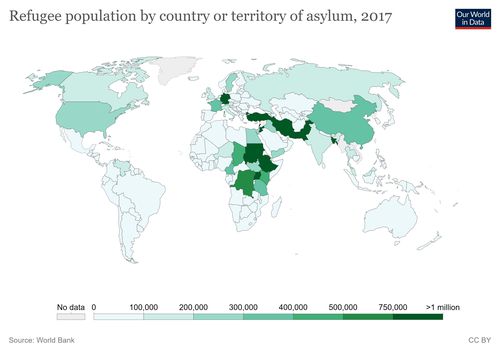
population of refugees around the world in 2017
There are many reasons why people leave their home countries. Some people may be looking for better employment. Some might want to explore new parts of the world, or to raise their families elsewhere. Others may move to pursue exciting educational opportunities. This type of voluntary movement from one country to another is called immigration. A person who chooses to move from one country to another to live there permanently is called an immigrant.
Unlike immigrants, some people are forced to leave their home country because of persecution, violence, or war in their home country. These people are called refugees, and they are worried about their safety. To protect themselves, refugees must flee from their home country and resettle in another one. Usually, refugees cannot return to their home countries after they leave because it is unsafe. This is another important difference between refugees and immigrants, as immigrants may return to their home countries if they want to and are able. The last important difference between refugees and immigrants is that refugees cannot be sent back to the country they are fleeing from. Immigrants, however, are subject to their new country’s immigration laws. This means immigrants can be turned away from entering a new country.
Refugees come from different countries around the world. In 2019, about 68% of refugees were from only five countries: Syria, Venezuela, Afghanistan, South Sudan, and Myanmar. In the same year, almost half the population of all refugees in the world were made up of children. Where did these refugees end up moving to? Often, the refugees fled to neighboring countries. But in some cases, the refugees moved across oceans to resettle in safer countries. By the end of 2019, Turkey, Colombia, Pakistan, Uganda, and Germany had the largest numbers of refugees.
Once someone has entered a new country in search of safety and protection, the person is not immediately considered a refugee. The country has to legally recognize someone as a refugee before that person can receive full protection. This process can take a long time in some countries, including the United States. When people have fled their home country and are waiting to be recognized as refugees, they are called asylum seekers. Many countries, like the United States, have laws and processes to determine if asylum seekers can become refugees officially. Since 1980, the United States has admitted refugees into the country every year. Refugees can apply to live and work in the United States without fear of being sent back to their home country.
The journeys and lives of refugees are difficult. They must leave their home communities to protect themselves and their families. Global organizations, like the United Nations and Amnesty International, work to support refugees. But countries and cities must also work to support their refugee populations. Refugees bring meaningful contributions to the communities they resettle to, including their homeland’s culture and history. In their own search for safety, refugees have become an important part of many communities worldwide.
Comprehension Questions
- because they are looking for better work
- because they want to explore the world
- because they are pursuing their education
- because they are worried for their safety
- Immigrants leave their homes for education while refugees leave their homes for work.
- Immigrants move to neighboring countries while refugees move to countries across oceans.
- Immigrants choose to leave their homes while refugees are forced to leave their homes.
- Immigrants want to raise their children elsewhere while refugees are fine staying where they are.
“Refugees come from different countries around the world. In 2019, about 68% of refugees were from only five countries: Syria, Venezuela, Afghanistan, South Sudan, and Myanmar. In the same year, almost half the population of all refugees in the world were made up of children.”
What conclusion can you draw from this evidence?
- In 2019, Syria, Venezuela, Afghanistan, South Sudan, and Myanmar experienced significant issues with safety.
- In 2019, the people of Syria, Venezuela, Afghanistan, South Sudan, and Myanmar had more children than usual.
- In 2019, there was a record-breaking number of refugees from different countries all over the world.
- In 2019, the majority of refugees were forced to move due to natural disasters like tsunamis, earthquakes, and hurricanes.
- Refugees are considered asylum seekers and never receive full protection status in the countries they move to.
- Refugees must wait to be officially recognized by the country they move to in order to have full protection there.
- Refugees must check in with legal authorities monthly for as long as they live in a country they were not born in.
- Refugees are only allowed to work in legal jobs in a new country, such as a lawyer or law enforcement officer.
- Refugees and immigrants both leave their home countries and move to new ones, but the two groups move for very different reasons.
- Refugees must be legally recognized by their new country before they receive full protection, which can be a long process.
- Refugees voluntarily leave their homes in search of better job options and educational opportunities in other countries.
- Refugees are forced to leave their homes due to safety concerns and resettle in new countries, which can be a long and difficult process.
“Once someone has entered a new country in search of safety and protection, the person is not immediately considered a refugee. The country has to legally recognize someone as a refugee before that person can receive full protection. This process can take a long time in some countries, including the United States. When people have fled their home country and are waiting to be recognized as refugees, they are called asylum seekers. Many countries, like the United States, have laws and processes to determine if asylum seekers can become refugees officially.”
As used in this excerpt, what does the phrase “recognize” most closely mean?
- to guide and support
- to question and critique
- to acknowledge and accept
- to encourage and empower
Refugees often flee to neighboring countries, _________ some make longer journeys across oceans to resettle.
- next
- but
- so
- last
8.In 2019, what portion of the world’s refugee population was children?
(written answer)
9.Why do organizations like the United Nations and Amnesty International work to support refugees? Use evidence from the text to support your answer.
(written answer)
10.Why is it important for communities to support refugee populations? Use evidence from the text to support your answer.
(written answer)


Không có nhận xét nào:
Đăng nhận xét