If the sun begins to shine after rainfall, you might see a glorious rainbow. But what makes a rainbow? Keep reading to find out.
Did you know that sunlight is made of many colors? It is a combination of every color of the rainbow. Sir Isaac Newton, a famous scientist from England, first made this discovery. Newton passed a triangular prism through a beam of sunlight. A triangular prism is usually made of glass, and its ends are triangles. When the beam of sunlight passed through the prism, it bent. The light separated into red, orange, yellow, green, blue, indigo and violet — all of the colors in the rainbow!
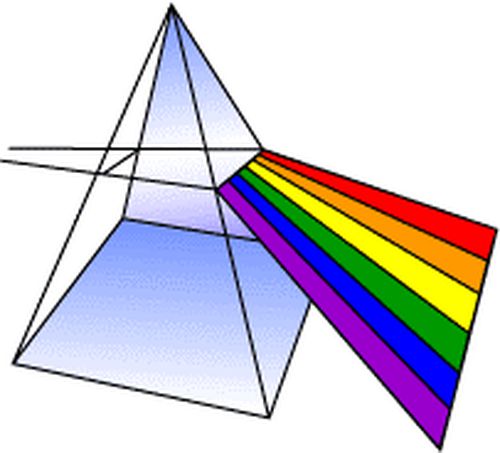
But there isn’t any triangular prism in the sky. So then how can you see a rainbow in the sky? Raindrops in the air act as prisms! In order to see a rainbow, the sun has to be behind you, and the clouds can’t be blocking the sunlight. The sunlight passes through the raindrops. Then the light is bent, the colors are separated, and a rainbow forms!
Comprehension Questions
1. You would be most likely to see a rainbow after a storm if 
- clouds cover the sky.
- the sun shines.
- the air becomes very dry.
- it gets very windy.
- clouds cover the sky.
- the sun shines.
- the air becomes very dry.
- it gets very windy.
2. What does the text describe? - how rainbows form
- Sir Isaac Newton’s famous discoveries
- how different types of discoveries are made
- experiments that include triangular prisms
- how rainbows form
- Sir Isaac Newton’s famous discoveries
- how different types of discoveries are made
- experiments that include triangular prisms
3. Read the following sentences:“Raindrops in the air act as prisms! In order to see a rainbow, the sun has to be behind you, and the clouds can’t be blocking the sunlight. The sunlight passes through the raindrops. Then the light is bent, the colors are separated, and a rainbow forms!”
In order for a rainbow to form, why can’t clouds be blocking the sunlight?
- The sunlight needs to reach the raindrops in order to bend them.
- The clouds need to bend the sunlight that passes through raindrops.
- The sunlight needs to act as a triangular prism.
- The sunlight needs to reach the raindrops in order to pass through them.
“Raindrops in the air act as prisms! In order to see a rainbow, the sun has to be behind you, and the clouds can’t be blocking the sunlight. The sunlight passes through the raindrops. Then the light is bent, the colors are separated, and a rainbow forms!”
In order for a rainbow to form, why can’t clouds be blocking the sunlight?
- The sunlight needs to reach the raindrops in order to bend them.
- The clouds need to bend the sunlight that passes through raindrops.
- The sunlight needs to act as a triangular prism.
- The sunlight needs to reach the raindrops in order to pass through them.
4. Which of these things helps to determine your ability to see a rainbow? - your height
- the number of mountains nearby
- your location
- the temperature outside
- your height
- the number of mountains nearby
- your location
- the temperature outside
5. This passage is mostly about - how rainbows are formed.
- Sir Isaac Newton’s career.
- the scientific uses of triangular prisms.
- what sunlight is made up of.
- how rainbows are formed.
- Sir Isaac Newton’s career.
- the scientific uses of triangular prisms.
- what sunlight is made up of.
6. Why does the author compare triangular prisms to drops of rain? Use evidence from the text to support your answer.
7. What happened when Sir Isaac Newton passed a beam of sunlight through a triangular prism?
8. Choose the word that best completes the sentence.Sunlight is made up of many colors, _________ red, orange, and yellow.
- especially
- above all
- particularly
- including
Sunlight is made up of many colors, _________ red, orange, and yellow.
- especially
- above all
- particularly
- including


Không có nhận xét nào:
Đăng nhận xét