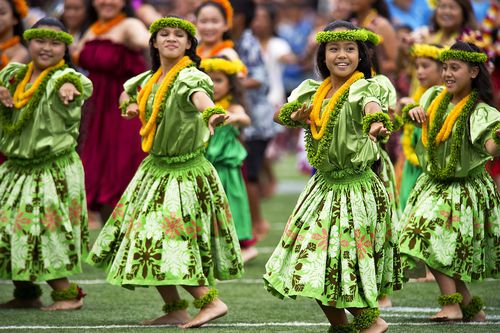
dancers performing hula dance
The Hula is a traditional Hawaiian dance. It is known partly for its smooth and graceful movements of the arms, hands, and hips. Hula dancers often mimic movements from nature. Their movements may look like trees in the wind or waves in the water. The dancers also tell a story with their movements. Chants, or mele, go along with the movements to help tell the story.
There are many myths as to how the hula dance originated. One legend says that Pele, the volcano goddess, danced the first hula dance. According to this myth, Pele was running from her sister, the goddess of the oceans. She was trying to find a place where she couldn’t be touched by the ocean waves. She finally found such a place. It was a chain of craters on the island of Hawaii. There, Pele danced the first hula to show that she had beaten her sister!
Although people today dance the hula freely, the dance was actually banned during part of the 1800s. It was banned by Christian missionaries who arrived in Hawaii in 1820. Before then, the hula was used in religious ceremonies. But the missionaries did not approve of the religious ceremonies the people of Hawaii were holding, or the dancing that went with them. After it was banned, the dance continued to be taught and danced secretly. But as more Hawaiians started becoming Christians, the dance became a dying part of Hawaiian culture.
All of this changed during the reign of Hawaii’s last king, David Kalakaua. He was the king from 1874 to 1891. He encouraged hula dancing to come back out into the open. As a result, the dance resurfaced, now with new movements, costumes, and song. Today, the hula tradition lives on in Hawaii.
Comprehension Questions
1. The hula is a traditional Hawaiian dance. Describe the movements in the hula dance. 
(written answer)
2. Even though the hula dance was banned by Christians who arrived in Hawaii in the 1800s, people from Hawaii continued to secretly teach and dance the hula. Based on this evidence, what conclusion can you draw about how people from Hawaii felt about the hula?
(written answer)
3. What is the main idea of this text?
(written answer)
4. Summarize the legend from the text about the first hula dance.
(written answer)
5. "Nature is important in Hawaiian culture." Argue for or against this statement using evidence from the text.
(written answer)


Không có nhận xét nào:
Đăng nhận xét