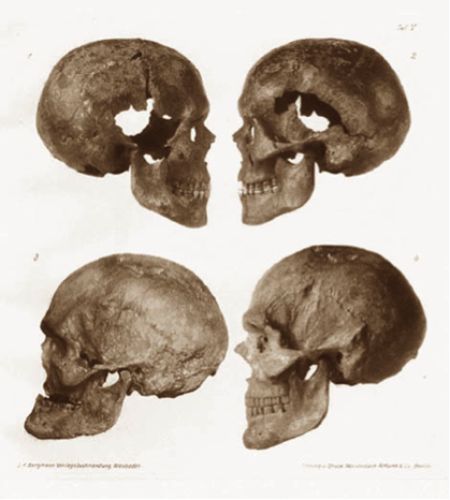
In the summer of 2012, paleontologists working on a fossil excavation in Kenya announced that the human race, as we know it, was never alone.
Scientists unveiled pieces of skull and bone that are approximately 2 million years old. Their discovery confirmed what earlier fossil findings had introduced as a possible piece of the human origin story: that humankind is merely one of a number of human-like species, each with its own lifespan. Every other species has been long extinct, making Homo sapiens, our species, the sole surviving member of the extended human family. Indeed, these findings have confirmed that the family was bigger than anyone had previously imagined.
In conversations about prehistoric evolution, whether humans evolved from apes, is a common but misleading question. Evolution, at its core, is a process that spawns a diversity of species. Some are quite similar and some are quite different. Some strains of evolution take place over millions of years, while other strains (for example, microorganisms that pass through multiple generations in the span of a day) take place over a number of months, even weeks. To track the evolution of various organisms over time is to reveal the natural world’s knack for never putting all of its bones in one basket, so to speak.
Dating Prehistoric Man: Not as Awkward as It Sounds
A more revealing question, then, is scientists’ inquiry into multiple branches of the Homo genus. Assembling a “fossil record” over the course of two centuries, scientists have amassed enough evidence to date the earliest known appearance of Homo sapiens to about 200,000 years ago. Their research has also proven that a number of human-like species preceded and accompanied Homo sapiens on the prehistoric timeline.
The creation and preservation of an accurate fossil record is no easy task. Bones dug up from the ground don’t often offer much information about their own age, so paleontologists have developed several methods to analyze the earth surrounding those bones instead. By inspecting the proximity of a fossil, one can figure out approximately (sometimes precisely) when the fossil itself was actually a living organism.
Radiometric dating—the use of technology to detect radioactive elements to identify the age of whatever those elements are in—is a precise but limited technique for determining the age of a fossil. The precision of radiometric dating comes from the fact that radioactive elements have clear, well-documented decay times (or how long it takes for traces of an element to disintegrate). Using this technique, scientists can narrow down the age of a fossil, even one that’s over 50 million years old, to a very close estimate. Unfortunately, radiometric dating only works when radioactive elements were present in the first place.
The alternative method of dating fossils is stratigraphy. Based in the geographic study of layers of sediment that have stacked on top of each other for ages, stratigraphy includes a host of techniques for analyzing these various layers to determine the age of objects found wedged within them.
Simply put: If people find a fossil between two layers of dirt, and they know how old those layers of dirt are, they can then say the fossil was part of a living creature between those dates.
Stratigraphy can be difficult to execute in the study of fossils, since dirt doesn’t always stack up in neatly preserved layers. There are often interruptions in the layers or portions of sediment that ended up being mixed together or eroded. Furthermore, the precision of this technique is said to be relative. Every estimate based on stratigraphic analysis depends on a comparison between other samples and other estimates.
Yet, by reviewing each other’s evidence and sharing their findings, researchers are able to make reasonable confirmations of the global fossil record. Radiometric dating and stratigraphic dating are used to establish prehistoric records of fossils. Those records are then used to build a logical timeline for the evolution of many species. When new fossils are dug up, a fossil record spanning the ages is there to help scientists figure out where their new discoveries fit into the stories of the earth.
To Err Is Human; to Evolve Is Much More
One of the most fascinating stories, of course, is the prehistory of the human race.
The National Museum of Natural History puts it eloquently: “While people used to think that there was a single line of human species, with one evolving after the other in an inevitable march towards modern humans, we now know this is not the case. Fossil discoveries show that the human family tree has many more branches and deeper roots than we knew about even a couple of decades ago.”
Presenting an interactive display of humanity’s prehistory, the museum identifies over 15 different species related to humankind. The fossil record reaches back over 6 million years, marking the earliest known appearance of a primate species that walked upright. Two million years later, the record proves the existence of Australopithecus Anamensis, a bipedal species that was equally adept at walking upright and climbing trees.
Homo habilis, whose fossils date back 2 million years ago, was the earliest known species of the Homo genus. The age of Homo habilis closely follows the first known appearance of stone tools. It also coincides with the existence of at least three other human-like species, ape-like creatures that also walked upright. The stone tools discovered from these years were likely used by all of the species, following evolutionary paths that were similar but far from identical.
Even Homo sapiens, the species encompassing every human being on the planet right now, were accompanied by similar species. To be exact, at least four other human species have been added to the fossil record for the past million years. The simultaneous existence of Homo erectus and Homo heidelbergensis, Homo floresiensis and Homo neanderthalensis covers a period when the human races developed much larger brains and began to form the basis for modern civilization.
One by one, the other races have gone extinct. The hypothesized reasons range from an inability to adapt to climate change to murder at the hands of more advanced humans. Disease, physical disadvantages, and natural disaster have been discussed as possible causes. Some scientists argue that Neanderthals may have bred with early populations of modern humans, changing the record of their extinction to one of possible assimilation.
Thus, precise causes for the ascendency of Homo sapiens have yet to be proven. The fact that fossils represent less than 5% of all known living species in the history of the world makes it very difficult for even the brightest paleontologists to gather enough evidence to answer all the questions they have about the origins of man.
What the world has gained through their work, though, is less a story of primates transforming into humans than it is the story of humanity’s many extinguished flames. At the moment, our human race carries the torch for millions of years of evolution—among species, across continents, and through the ages.
Comprehension Questions
1. What are Homo sapiens? 
- the use of technology to detect radioactive elements
- a fossil record that covers two centuries
- our species, the human race
- a species that has gone extinct
- the use of technology to detect radioactive elements
- a fossil record that covers two centuries
- our species, the human race
- a species that has gone extinct
2. What sequence of events does this passage describe? - This passage describes the daily routine of Homo neanderthalensis and Homo heidelbergensis.
- This passage describes the appearance and disappearance of different species related to humans.
- This passage describes the steps that paleontologists took to find pieces of human skull and bone in Kenya.
- This passage describes the assembly of a fossil record that dates Homo sapiens to about 200,000 years ago.
- This passage describes the daily routine of Homo neanderthalensis and Homo heidelbergensis.
- This passage describes the appearance and disappearance of different species related to humans.
- This passage describes the steps that paleontologists took to find pieces of human skull and bone in Kenya.
- This passage describes the assembly of a fossil record that dates Homo sapiens to about 200,000 years ago.
3. Fossils can provide information about the history of humankind.What evidence from the passage supports this statement?
- “Assembling a ‘fossil record’ over the course of two centuries, scientists have amassed enough evidence to date the earliest known appearance of Homo sapiens to about 200,000 years ago.”
- “At the moment, our human race carries the torch for millions of years of evolution—among species, across continents, and through the ages.”
- “Some scientists argue that Neanderthals may have bred with early populations of modern humans, changing the record of their extinction to one of possible assimilation.”
- “The simultaneous existence of Homo erectus and Homo heidelbergensis, Homo floresiensis and Homo neanderthalensis covers a period when the human races developed much larger brains and began to form the basis for modern civilization.”
What evidence from the passage supports this statement?
- “Assembling a ‘fossil record’ over the course of two centuries, scientists have amassed enough evidence to date the earliest known appearance of Homo sapiens to about 200,000 years ago.”
- “At the moment, our human race carries the torch for millions of years of evolution—among species, across continents, and through the ages.”
- “Some scientists argue that Neanderthals may have bred with early populations of modern humans, changing the record of their extinction to one of possible assimilation.”
- “The simultaneous existence of Homo erectus and Homo heidelbergensis, Homo floresiensis and Homo neanderthalensis covers a period when the human races developed much larger brains and began to form the basis for modern civilization.”
4. Imagine that a group of scientists has just dug up a fossil. What would probably give them the most information about the age of that fossil? - the fossil itself
- the earth around the fossil
- the air around the fossil
- the water around the fossil
- the fossil itself
- the earth around the fossil
- the air around the fossil
- the water around the fossil
5. What is this passage mostly about? - the appearance and behavior of Homo heidelbergensis
- the question of whether humans evolved from apes
- the use of radiometric dating to determine the age of fossils
- the development and fossils of prehistoric humans
- the appearance and behavior of Homo heidelbergensis
- the question of whether humans evolved from apes
- the use of radiometric dating to determine the age of fossils
- the development and fossils of prehistoric humans
6. Read the following sentence: “If people find a fossil between two layers of dirt, and they know how old those layers of dirt are, they can then say the fossil was part of a living creature between those dates.”What does the word fossil mean in the sentence above?
- the slow development of a species over time
- part of a living thing that has died and remained in the ground for a long time
- a method that scientists use to determine the age of bones they find in the ground
- an early human-like species that walked upright and probably used stone tools
What does the word fossil mean in the sentence above?
- the slow development of a species over time
- part of a living thing that has died and remained in the ground for a long time
- a method that scientists use to determine the age of bones they find in the ground
- an early human-like species that walked upright and probably used stone tools
7. Choose the answer that best completes the sentence below.There are several methods for dating fossils, ______ stratigraphy and radiometric dating.
- therefore
- earlier
- also
- including
There are several methods for dating fossils, ______ stratigraphy and radiometric dating.
- therefore
- earlier
- also
- including