This text and images are provided courtesy of the New-York Historical Society.
Before Thanksgiving every year, hundreds of people gather on 77th Street in New York City to watch a Thanksgiving tradition: the inflation of the Macy’s Thanksgiving Day Parade balloons. Today, the exuberant parade, a roasted turkey, and family gatherings on the fourth Thursday in November are all hallmarks of the holiday, but they haven’t always been. Check out some of these fun facts about Thanksgiving traditions, past and present.
The First Thanksgiving Feast—not just turkey!
Almost every elementary school in the United States probably does a lesson on that November day in 1621 when pilgrims and Wampanoag tribespeople joined together for a magnificent feast to celebrate a good harvest—the first Thanksgiving.
First it should be noted that historians disagree about how friendly and magnificent this feast was. Some Wampanoag leaders today say that the 90 or so Wampanoags who ended up feasting with the pilgrims weren’t actually invited. Rather they heard colonists firing guns and showed up to see what was going on. This was early in their relationship, and pilgrims relied heavily on the Wampanoag while still not regarding them as equals. For example, Wampanoag leader Massasoit maintained trade and a peace treaty with these colonists. People under Massasoit's leadership even taught these same colonists how to farm in their new home.
Despite the notion that this meal was likely not the harmonious peacemaking we often frame it as, there is some evidence from colonists that a meal occurred. We also know giving thanks for harvests was part of both pilgrim and Wampanoag heritage. So was their feast like ours today? What did they eat?
Only two first-hand accounts of that feast exist: one by Edward Winslow, who mentioned in Mourt’s Relation that they ate “fowle" and “five deere," and another by William Bradford, who mentions in Of Plymouth Plantation “codd, bass & other fish" as well as venison, wild turkeys, and Indian corn.
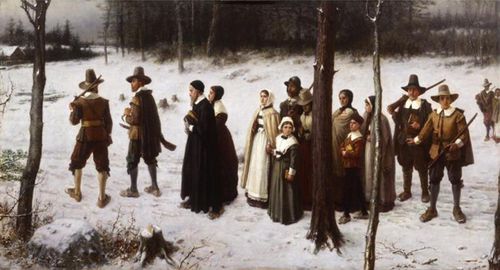
Pilgrims Going to Church by George Henry Boughton from the collections of the N-YHS
Thanksgiving Becomes a National Holiday
That 1621 meal was certainly the first day of Thanksgiving recorded in the American colonies, but it was not the start of the Thanksgiving we know today. This was just one of many days of Thanksgiving decreed by colonial religious leaders, government officials, and even army commanders to give thanks for major events. Setting aside feast days, fasting days, or prayer days was a tradition colonists brought with them from Europe.
During the American Revolution, days of Thanksgiving were decreed in 1777 and 1784. George Washington declared another on November 26, 1789, to give thanks to the divine for our new nation. Slowly, states followed suit and declared their own annual days of Thanksgiving, but it was not until 1863 when Abraham Lincoln declared a national day of Thanksgiving that the holiday tradition truly began. And we can’t give Lincoln all the credit—the true crusader for a national day of Thanksgiving was a woman named Sarah Josepha Hale.
After being widowed with five children at the age 34, Hale, a self-educated woman, embarked on an extraordinary career. She wrote many successful books and poems—including “Mary Had a Little Lamb"—and then became, in her words, the “editress" of Godey’s Lady’s Book, the most widely read magazine of the 19th century. From the 1830s up to Hale’s death in 1871, she petitioned for a Thanksgiving holiday. She wrote to President Lincoln in 1863:
You may have observed that, for some years past, there has been an increasing interest felt in our land to have the Thanksgiving held on the same day, in all the States;…As the President of the United States has the power of appointments for the District of Columbia and the Territories; also for the Army and Navy and all American citizens abroad who claim protection from the U. S. Flag could he not, with right as well as duty, issue his proclamation for a Day of National Thanksgiving for all the above classes of persons? And would it not be fitting and patriotic for him to appeal to the Governors of all the States, inviting and commending these to unite in issuing proclamations for the last Thursday in November as the Day of Thanksgiving for the people of each State? Thus the great Union Festival of America would be established.
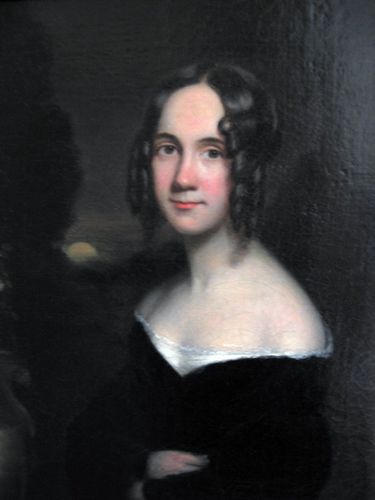
https://upload.wikimedia.org/wikipedia/commons/c/c1/Sarah_Hale_portrait.jpg
Portrait of Sarah Hale
Hale got her wish when Lincoln issued his proclamation for a national day of Thanksgiving first in 1863 and then again in 1864. Unfortunately for Hale, the national holiday didn’t become an official, federal holiday until 1941, when it was established through an act of Congress and signed into law by President Franklin Delano Roosevelt.
Days of Thanksgiving during the Civil War united families in a common celebration, even though they were often separated.
A Parade Floats onto the Scene
The unfortunate souls celebrating days of Thanksgiving in the 19th century had to do so without the spectacle of an elaborate urban parade. The first official Thanksgiving Day Parade started in Philadelphia in 1920. But the parade-to-beat-all-parades began in New York City with the R.H. Macy Department Store in 1924.
Macy’s business was booming—it had just expanded to become the largest department store in the nation. The staff, most of them first generation immigrants, wanted to celebrate their new homeland and new traditions with the type of celebratory pageant they remembered from their birthplaces: a parade! In 1924, Macy’s put on a Christmas (yes, Christmas) parade on Thanksgiving Day. It travelled all the way from 145th Street to 34th Street, where Santa was crowned “King of the Kiddies" on the Macy’s Herald Square balcony. This first parade did not feature balloons but did feature live animals from the Central Park Zoo.
A few years later, rubber balloons replaced the not-always-cooperative wild animals. A 60-foot dinosaur flanked by handlers dressed as cavepeople (not historically accurate) was the crown jewel of the 1927 parade. Over time, the number of parade floats and balloons increased, but the route shortened to make it more TV-friendly. New balloons debut most years. Three recent favorites include one featuring characters from the Trolls movie, one featuring the main character from Diary of a Wimpy Kid, and one called “Trixie the Dog. "
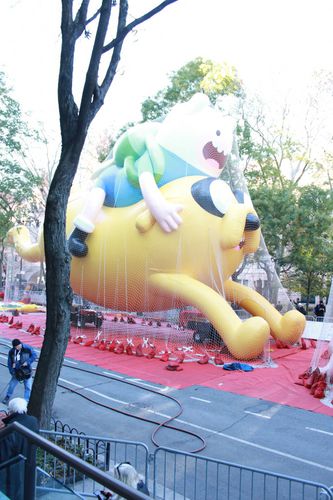
New-York Historical Society
A float being prepared for the 2015 Macy's Thanksgiving Day Parade
Comprehension Questions
1. What did pilgrims and Wampanoag share in 1621, which later became known as the first Thanksgiving? 
(written answer)
2. In the 1800s, what were days of Thanksgiving meant to celebrate? Support your answer with details from the text.
(written answer)
3. What is one Thanksgiving tradition that began in the 1900s and continues today?
(written answer)
4. How has Thanksgiving changed over time? Support your answer with details from the text.
(written answer)
5. What is the main idea of this text?
(written answer)


Không có nhận xét nào:
Đăng nhận xét