When an airplane is in flight, there is a downward force (gravity) and an upward force (lift) acting on the airplane. As an airplane moves through the air, the shape of the wings causes there to be less air pressure pushing down on the wings than pushing up on the wings. This difference in pressure yields the upward lift. If the downward gravitational force is less than the upward lift, then the airplane stays in the air. Read on for a more detailed explanation.
Fact 1. As an airplane's propellers spin, they give the airplane a forward force (thrust). As the airplane moves forward there is a backward force (drag) caused by the resistance of the air.
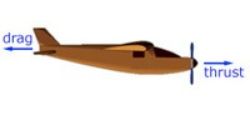
Fact 2. An airplane is attracted downward due to gravity. This force increases with the mass (weight) of the object.
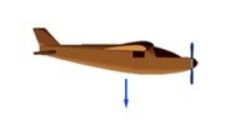
Fact 3. As an airplane moves forward, the shape of its wing creates lower pressure above the wing than below, yielding a net upward force known as lift.
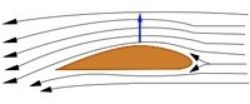
As an airplane speeds along the runway, the airplane's wings disrupt the flow of the air. This disruption causes the air above the wings to move faster than below the wings. As a result, the air pressure above the wing is less than below the wing. As the airplane speeds up, this pressure difference increases until the lift is stronger than the gravitational force, and the airplane takes off. In order to remain in flight, the thrust must be greater than the drag, and lift must be greater than the force of gravity.
There is still some debate as to the exact cause of the difference in the air's speed around the wings. The basic concept described here, however, seems to explain why an airplane can fly.
There is still some debate as to the exact cause of the difference in the air's speed around the wings. The basic concept described here, however, seems to explain why an airplane can fly.
Comprehension Questions
1. What is the downward force that acts on an airplane in flight? 
- lift
- drag
- thrust
- gravity
- lift
- drag
- thrust
- gravity
2. As an airplane moves forward, the shape of its wings causes a difference in pressure below and above the wings. What is the effect of this difference in pressure?
- a downward force is created
- the airplane speeds up
- an upward force is created
- the airplane slows down
- a downward force is created
- the airplane speeds up
- an upward force is created
- the airplane slows down
3. Read these sentences from the text.
“As an airplane’s propellers spin, they give the airplane a forward force (thrust). […] As an airplane moves forward, the shape of its wing creates lower pressure above the wing than below, yielding a net upward force known as lift.”
Based on this evidence, what conclusion can be drawn about thrust and lift?
- Airplanes do not need lift to fly, as long as they have thrust.
- Airplanes need lift in order to create thrust.
- Airplanes can create lift without any thrust.
- Airplanes need thrust in order to create lift.
“As an airplane’s propellers spin, they give the airplane a forward force (thrust). […] As an airplane moves forward, the shape of its wing creates lower pressure above the wing than below, yielding a net upward force known as lift.”
Based on this evidence, what conclusion can be drawn about thrust and lift?
- Airplanes do not need lift to fly, as long as they have thrust.
- Airplanes need lift in order to create thrust.
- Airplanes can create lift without any thrust.
- Airplanes need thrust in order to create lift.
4. Which of the following would probably help an airplane to take off and remain in flight?
- having a large body and small wings
- moving at a slow speed while on the ground
- being made from a lightweight material
- carrying heavy luggage inside the plane
- having a large body and small wings
- moving at a slow speed while on the ground
- being made from a lightweight material
- carrying heavy luggage inside the plane
5. What is the main idea of this text?
- Airplanes fly as a result of the forward force of thrust being greater than the backward force of drag.
- The upward force called lift is caused by a difference in air pressure above and below an airplane’s wings.
- Four different forces called thrust, drag, lift, and gravity, all prevent airplanes from being able to fly.
- Airplanes fly as a result of the upward force of lift being greater than the downward force of gravity.
- Airplanes fly as a result of the forward force of thrust being greater than the backward force of drag.
- The upward force called lift is caused by a difference in air pressure above and below an airplane’s wings.
- Four different forces called thrust, drag, lift, and gravity, all prevent airplanes from being able to fly.
- Airplanes fly as a result of the upward force of lift being greater than the downward force of gravity.
6. Why might the author have chosen to include three diagrams in this text?
- to illustrate the forces being discussed
- to introduce new information into the text
- to give examples of how different planes fly
- to provide an alternate explanation of how planes fly
- to illustrate the forces being discussed
- to introduce new information into the text
- to give examples of how different planes fly
- to provide an alternate explanation of how planes fly
7. Choose the answer that best completes the sentence below.
As an airplane speeds along the runway, the airplane’s wings disrupt the flow of the air. ____, the air above the wings moves faster than below the wings.
- However
- As a result
- For instance
- Previously
As an airplane speeds along the runway, the airplane’s wings disrupt the flow of the air. ____, the air above the wings moves faster than below the wings.
- However
- As a result
- For instance
- Previously


1-D, 2-C,3-D,4-C,5-D,6-A,7-B,
Trả lờiXóa8-As an airplane's propellers spin, they give the airplane a forward force (thrust).
9-As an airplane speeds along the runway, the airplane's wings disrupt the flow of the air. This disruption causes the air above the wings to move faster than below the wings. As a result, the air pressure above the wing is less than below the wing. As the airplane speeds up, this pressure difference increases until the lift is stronger than the gravitational force, and the airplane takes off.In order to remain in flight, the thrust must be greater than the drag, and lift must be greater than the force of gravity:airplane's propellers spin.
10-no propeller-no propeller spin-no forward force (thrust)-no lìt
very good. You got about 7/10.
Xóa